Free Printable Visual Schedule for Autism
Free visual schedule printable for autism: now/next/later strip, daily schedule, 24 labelled step cards and a start guide. Letter and A4 PDF, no sign-up.
What it is
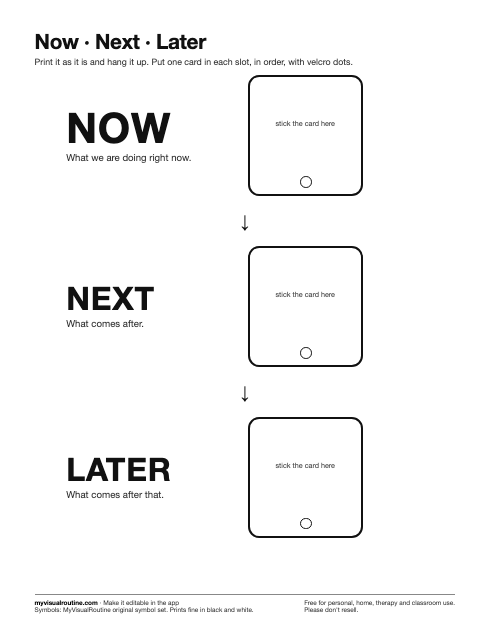
A six-page PDF set. A now/next/later strip, a six-slot daily schedule with a finished pocket, 24 step cards, blank cards and a one-page start guide.
Who it is for
Parents, therapists and teachers who want a paper visual schedule to cut out and use tomorrow, for a child who does well with pictures and words together.
How to use it in 3 steps
- Print pages 1 to 5 at 100% and cut out the cards on the dashed lines.
- Laminate, add velcro dots, and start with just three cards your child already does.
- Point to the card, say the word once, do the step together, then move the card to Finished.
Download the PDF
6 pages. Free, no sign-up. Prints in black and white too.
Free for personal, home, therapy and classroom use. Please don't resell.
Make it editable in the app
Want your own photos, your own steps, timers or a recorded voice? Build the same free printable visual schedule for autism in MyVisualRoutine. Free to start, with an optional Premium upgrade.


What is in the set?
Six pages, one PDF, no email needed. Print the whole file or only the pages you want.
- Page 1: a vertical Now, Next, Later strip with three card slots
- Page 2: a daily schedule with six slots and a Finished pocket
- Pages 3 and 4: 24 step cards with a picture and a word each
- Page 5: 12 blank cards for anything not in the set
- Page 6: a one-page “how to start” sheet
The step cards cover the usual day: wash face, use toilet, wash hands, brush teeth, get dressed, comb hair, eat breakfast, put on shoes, put on coat, get backpack, school, eat lunch, have a snack, outdoor play, free play, homework, time to go, eat dinner, take a bath, put on pajamas, read a story, go to sleep, wait and all done. Each card is 2 inches (5 cm) wide, a good size for a velcro dot and a small hand.
The pictures come from the symbol set in the MyVisualRoutine app. Thick outlines and a printed word on every card mean the set also prints well on a black and white printer.
How do I set it up in 10 minutes?
Print, cut, stick, hang. Here is what the finished board looks like.
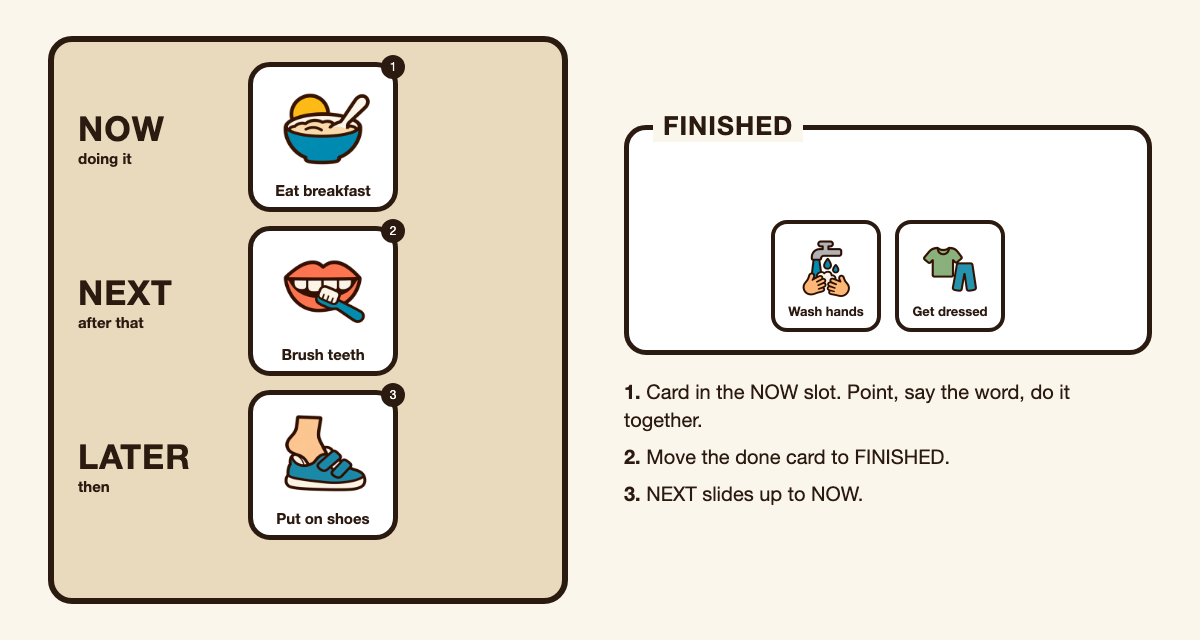
- Print pages 1 to 5 at 100%. Choose “actual size”, not “fit to page”, so cards stay 2 inches wide.
- Cut the cards on the dashed lines. Scissors and a ruler are enough.
- Make them last. Laminate, or use clear sleeves. Stick the rough side of a velcro dot on each slot and the soft side on the back of each card.
- Choose three steps your child already does most days. Put them in Now, Next and Later.
- Hang the strip at your child’s eye level where the routine happens, such as by the door or the bathroom mirror.
- Put the other cards in an envelope nearby, so the board stays clean and the choices stay few.
How many steps should I start with?
Three. A Now, Next and Later strip is enough for the first week.
If your child already follows a few steps without trouble, try the daily page with six slots. A shorter schedule that works beats a long one that overwhelms. Add a card only when the current ones feel easy.
For a single step followed by a reward, a first-then board is an even smaller place to start.
How do I teach it? Prompt, then fade
Teach the board before you rely on it. AFIRM’s visual supports guide describes helping the learner to the schedule, using short, clear words, and repeating the steps until the learner can follow the sequence independently. It also tracks how much prompting the learner needs. A simple home version:
- Walk over together. Point to the Now card and say its word once.
- Do the step together. Then move the card to Finished side by side.
- Point only. After a few days, point to the board and wait a few seconds before you help.
- Let the card do the asking. Stay quiet and see if your child goes to the board.
Go slower if your child is stressed. If something changes, swap the card before the moment arrives, using a blank card if you need one. A speech-language pathologist, OT or BCBA who knows your child can tailor this.
Why use pictures at all?
AFIRM lists visual supports as an evidence-based practice for autistic learners. It defines them as “concrete cues that are paired with, or used in place of, a verbal cue” and lists schedules as one of three types. The 2020 review it builds on (NCAEP) includes visual supports as an evidence-based practice.
TEACCH, the North Carolina autism program, teaches Structured TEACCHing, whose components include schedules alongside physical organization, work systems, routines and task organization.
That does not mean a printable will work for every child. It is a starting point, and many families find they adjust it after a week or two. For the full how-to, see how to create a visual schedule for autism.
Morning and bedtime: which cards first?
Start with the routine that causes the most trouble.
- Morning: eat breakfast, brush teeth, get dressed, put on shoes. More ideas in the morning routine visual schedule guide.
- Bedtime: take a bath, put on pajamas, brush teeth, read a story, go to sleep. See the bedtime visual schedule guide.
Paper or app: when do printables stop being enough?
Paper is great for a fixed routine at home. It gets awkward when the plan changes every day, you want your child’s own photos, or you are out of the house.
That is where an app helps. MyVisualRoutine lets you build schedules with your own photos and steps, add timers and a recorded voice, and change tomorrow’s plan in a minute. It is free to start, with an optional Premium upgrade. I build it on my own, and the printable set above stays free either way. For more tools, see all resources.
Questions
Do I need to laminate visual schedule cards?
No, but it helps. Printed paper tears and gets crumpled by small hands. Laminating, clear card sleeves or clear packing tape over each card will make them last. The cards print fine on regular paper or on card stock.
Do I need velcro for a visual schedule?
Velcro dots are the easiest way to let a child move cards, but they are not required. A magnet strip, a pocket chart, or a ring of cards on a clip also work. Pick whatever your child will actually handle.
How many cards should a visual schedule have?
Start with three, the Now, Next and Later slots, using steps your child already does. Move to the six-slot daily page when three feel easy. There is no right number, so go at your child's pace.
What age is a visual schedule for?
Visual supports have been studied with learners from early childhood through young adulthood. Younger children usually start with a picture plus the word. Older children may move to written words only, or a checklist.
Can I print the cards in black and white?
Yes. Every card has a thick outline and a printed word, so it reads clearly in greyscale. Colour printing is nice but not needed.
Can I edit these cards or add my own photos?
Not in the PDF, but the blank cards let you write or draw your own. For your own photos, steps, timers and recorded voice, the MyVisualRoutine app does that, and it is free to start.
Make it editable in the app
Use your own photos and steps, add timers and a recorded voice. Free to start, with an optional Premium upgrade.